“You don’t make a photograph just with a camera. You bring to the act of photography all the pictures you have seen, the books you have read, the music you have heard, the people you have loved.”
– Ansel Adams
I’ve been addicted to photography all my life. I started as a toddler at my dad’s side as he worked in our family’s newspaper darkroom, and he taught me about photography using a 4×5 press camera. My first camera was a blue plastic hand-me-down Kodak Brownie Flash 20 my older brother gave me when I was six. I’ve since progressed through 4×5 field cameras, 35mm SLRs and now use digital cameras. I spent years in the darkroom learning the alchemy of film, paper, and chemicals. I could no more stop making photographs than I could stop breathing.
But for decades, I didn’t see photography as something a responsible adult should do for a living. It was what I did in the margins—early morning stops at crane marshes on my commute, weekend trips to photograph wetland prairies and orchid bogs, stolen hours in the darkroom after work. Whatever we were doing, when there was dramatic light falling on the landscape I felt like I was wasting an opportunity if I didn’t have a camera in my hand. (I still do that.)
Meanwhile, I built what I thought were “sensible careers”. I studied outdoor recreation and environmental education at Indiana University, worked as a seasonal naturalist at Indiana Dunes National Lakeshore, then moved to Michigan for a position at a large regional nature center. When that didn’t pay enough to support a family, I went back to school for a master’s in landscape architecture—a field that blended art, design, and environmental science. I spent years evaluating sites for parks and greenways, designing regional and neighborhood parks, designing and implementing ecological restoration projects, learning to see landscapes as compositions of line, form, color, texture, and ecological health. Practical work. Steady income. My family wouldn’t starve. Photography could wait.
Was I hiding from my calling, or was I preparing for it? I honestly don’t know. Steven Pressfield calls this kind of thing “shadow careers”—pursuits that feel adjacent to what we’re meant to do but allow us to avoid the risk and commitment our true work demands. That diagnosis stings because it’s probably true. But those years also taught me things I couldn’t have learned any other way. The naturalist work gave me ecological literacy—I can read landscapes as living systems, recognize relationships most people miss, understand what’s present and what’s absent. The landscape architecture training taught me to evaluate compositions with the same rigor I once applied to site planning: line, form, color, texture, slope, aspect, sight lines. Decades of leading nature walks taught me how to relate nature to other people’s lives, making it real and personal for them. I couldn’t make the photographs I make now without that foundation.
So were those years wasted, or essential? I think they were both. I was hiding, yes—afraid to claim photography as legitimate work, afraid to risk failure, afraid to disappoint people who expected me to be practical. But I was also learning to become the photographer I needed to be. Maybe that’s the uncomfortable truth: sometimes we prepare for our calling by avoiding it, and the avoidance itself becomes the training. Or maybe I’m just making peace with the long road I took to get to today.
It wasn’t until I made the leap and moved to Jackson, Wyoming—on the doorstep of Grand Teton and Yellowstone—that I gave myself permission to treat my photography as legitimate art. Not a hobby. Not something I did on weekends. My life’s work.
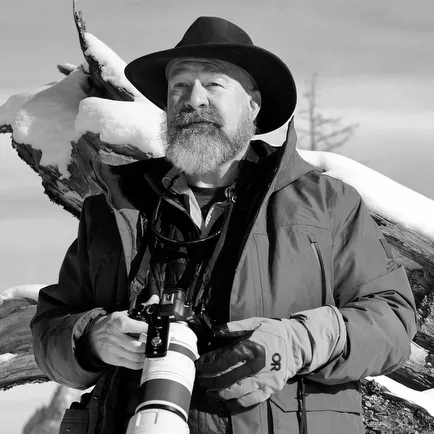
What I’ve come to understand is that making photographs is never a solitary act. As Ansel Adams said, “You don’t make a photograph just with a camera. You bring to the act of photography all the pictures you have seen, the books you have read, the music you have heard, the people you have loved.” I’d add: all the landscapes you’ve evaluated, all the ecosystems you’ve studied, all the years you spent learning to see. Rick Rubin puts it this way: “Nothing begins with us… You are never alone when you’re making art. You are in a constant dialogue with what is and what was.”
I’ve also learned that being a working photographer doesn’t mean I’m always behind the camera. I’m very much a one man band, wearing several different hats to make the work. Planning a trip, I’m one person. Packing gear, I’m another. Scouting locations, evaluating light, working with cameras, culling images, editing, printing—each stage calls forth a different version of me. One of my recreation professors as an undergrad assigned an article titled “The Healthy Happy Human Being Wears Many Masks,” about how we’re situationally different in different settings. It stuck with me. Because it’s true. I really am different selves at different stages of the work, and each one has to stay engaged, excited, and on-point; or something falls through the cracks.
I only recently realized that my photographs reflect all of this—the years of training I didn’t know I was getting, the ecological understanding, the design rigor, the patient observation, the multiple selves working at becoming who I am today. I’m never going to be chasing the shot everyone else is making. In my photographs, I strive to reveal context, complexity, and connection—showing wild subjects within the environments that sustain them, emphasizing the relationships that make a place what it is.
So, in a nutshell, I’ve been a photographer my whole life. It just took me a long time to gain all of the knowledge and skills I needed to become the photographer I’ve always wanted to be.