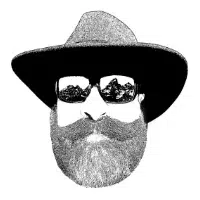
I hope that you enjoy viewing these works half as much as I enjoy bringing them to you.
— Brian Creek, Gardiner, Montana
Brian Creek approaches the wild parts of the world as subjects with agency, identity, and spirit. His work grows from a deep love and respect for all things wild, and a conviction that humans are part of the natural world, not separate from or above it. Going into wilderness—any wilderness—feels like coming home to him. Brian’s photography focuses on the unique beauty of these places and our innate connection to the Earth, a connection the ecologist and natural historian E. O. Wilson called “biophilia”, humanity’s attraction to the natural world.
Brian’s artistic style has evolved over his years of working in nature. He photographs wild subjects using the same approach he’d use in making an environmental portrait of a human: treating them as individuals in the places where they live, work, and play. An environmental portrait of someone fly fishing in a river or riding their horse in the mountains tells you a rich story about them that we’d never get from a headshot. Weather, season, light, and geography aren’t background—they’re essential context.
This is what “Portraits of Nature” means: showing wild places and wild things without human intrusion, in the environments that have shaped them. Brian makes photographs for himself and for other biophiliacs. People who share his innate, passionate love for nature and deep, biologically driven desire to connect with our planet.
The galleries are organized by subject. Browse them at your own pace, or use tags (found at the top of each gallery) to discover, for instance, all wolves, all winter photographs, all Yellowstone photographs—or any combination. Click any image to view it full-screen.
no images were found
Landscapes
If I had to limit myself to a single genre of photography, it would be landscape photography. My approach to photography, Portraits of Nature, comes from my training and education as an artist, naturalist, and landscape architect, and helps me translate the vast and achingly complex natural world. I use my cameras to share the relationships and connections I see in nature, using light and design to give you a seat right beside me, inviting you to enter the composition and immerse yourself in the frozen moment.
no images were found
Wildlife
I approach wildlife as subjects with agency, identity, and spirit. My work grows from my love and respect for the wild and a conviction that humans are part of the natural world, not its owners. I make photographs that others aren’t making—artistic work that contains deeper meaning for those willing to look closely. I want my fellow humans to understand that wildlife — animals and plants — need healthy, complex landscapes to survive, and that we are stewards of this planet with a responsibility for restoring Earth’s ecological integrity, simply because we are the only ones that can. My goal is to make photographs that reveal the beauty, relationships, behaviors, and the complexity of our wild cousins in the places that they call home in a way that lets you feel as if you are right there with me.
no images were found
Black & White
Black and white photography is in my genetic makeup. I started as a toddler at my dad’s side as he worked in our family newspaper’s darkroom in the 1960s, and Dad continued to be my photography tutor for many years. I cut my teeth as a large-format black-and-white photographer, so Ansel Adams has had an outsized influence on me. When making monochrome photographs, using any kind of camera, I slow down and let my mind translate the world into pure black, pure white, and nine shades of gray. I make a conscious effort to make each photograph with a clear vision of the final print in mind, and work backward from there. I believe this slower, more deliberate approach is clearly evident in my black and white photography. It has a distinctive feel that separates it from my color work. I think it is more elemental, revealing the world in a unique and timeless way.